
Dr. Kreena Patel
Biodentine® and the Bio-Bulk Fill technique have transformed clinical workflows for Specialist Endodontist Dr. Kreena Patel. In this article, she explains how this combination supports pulp preservation, simplifies procedures, and delivers superior patient care. Plus, she shares her expert tips for maximizing success with Biodentine® and Bio-Bulk Fill.
Since its launch in 2009, Biodentine® has demonstrated consistent success as a restorative and endodontic material. With proven bioactivity, biocompatibility, mechanical strength, and dimensional stability¹, this ultra-pure tricalcium silicate cement has helped countless practitioners to provide sustained dental health to their patients. And as Dr Kreena Patel has also discovered, Biodentine® offers a wealth of practical benefits for the clinician, too.
A Specialist in Endodontics, Dr Patel has been using Biodentine® for more than a decade, primarily for pulp capping, pulpotomy, and perforation repair. Having previously applied Biodentine® in a thin layer underneath glass ionomer cement (GIC), she switched to the Bio-Bulk Fill technique with Biodentine® three years ago. This technique involves filling a cavity in one step with a bulk mass of Biodentine® before placing a final composite restoration over the top.
Here, Dr Patel explains how Biodentine® helps practitioners to overcome the limitations of traditional restoration materials and reap the many practical benefits of the Bio-Bulk Fill procedure with Biodentine® for deep cavity restorations.
When using Biodentine® under GIC, Dr. Patel recalls lengthier procedures with more clinical stages. Now, Dr Patel says:
“I almost always use Biodentine® in a one-step procedure. There’s no need for multiple layers or thin increments—I can simply fill the tooth with a single material and place the composite directly over Biodentine®. This streamlines the process, reduces the risk of errors, and saves valuable clinical time.”
Another benefit of the Bio-Bulk Fill with Biodentine® is its capacity to be applied in a thick section over the dentine or exposed pulp, thanks to its strong dentine-like mechanical properties¹.
“I prefer the Bio-Bulk Fill technique because it allows me to place a thick increment of material into the cavity. This minimizes the risk of disturbing the material closest to the pulp when I place my coronal composite restoration, and allows me to complete the restoration in a single visit with confidence.”
Biodentine lends itself well to this use because it has very similar mechanical properties to natural dentine. After 24 hours, its compressive strength progressively increases, reaching a final compressive strength similar to that of natural dentine by day 28.2,3 In contrast, the compressive strength of GIC remains lower than that of Biodentine® throughout this period, and actually starts to decline after seven days.2
Dr Patel notes that when using Biodentine® in the Bio-Bulk Fill technique, its consistency makes mixing, handling, and placement much quicker and easier compared to materials like mineral trioxide aggregate (MTA), which can take 4+ hours to fully set.4 The working time gives ample time to manipulate and shape the Biodentine, while the optimal flowability and adaptability allow for strong, uniform adhesion to the cavity walls, ensuring a long-lasting seal and outstanding protection against microleakage. 5,6
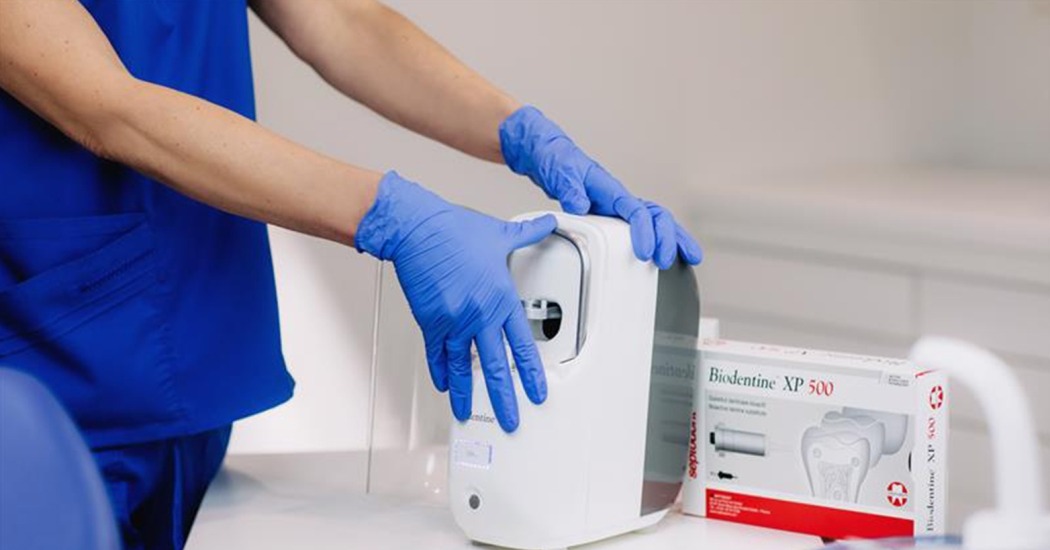
Handling and placement of Biodentine® became even easier with the development of the next-generation Biodentine® XP system. Presented in a ready-to-mix cartridge format, Biodentine® XP is placed directly into the cavity using an applicator gun with a flexible nozzle. It offers all the clinical benefits of Biodentine®, but with even greater efficiency for daily usage in one- or two-session procedures with the Bio-Bulk Fill technique.
Although 12 minutes is short in terms of setting time, Dr Patel notes that it can feel like a long wait in the chair, particularly for young or anxious patients.
To ensure the procedure runs smoothly for all involved, Dr Patel first emphasises the importance of allocating sufficient time for setting when scheduling the appointment. She says:
“I always build at least 15 minutes into the appointment for Biodentine® to set. If you haven’t planned for this or prepared the patient for the wait, you risk feeling rushed at this critical stage.”
Secondly, Dr Patel recommends proactively managing the patient’s expectations. She discusses the setting time with them ahead of the appointment and encourages them to bring headphones or a book to pass the time. After setting an audible alarm, she tells the patient:
“Listen, I’ve set a timer for 12 minutes. Do not let me touch the tooth until that timer goes off, because I’m not meant to but I always want to!”
This, she says, gives the patient a sense of involvement and control in the process, and makes them feel that they’re “in it together.”
During the wait, Dr Patel always sits the patient up in the chair. After making sure the patient is comfortable and occupied, she and her team are then free to complete tasks like clinical notes, tidying, and preparation.
A missing wall presents a number of technical challenges when using Biodentine in a single-stage technique. Dr Patel recommends rebuilding missing walls with composite before placing Biodentine®. She says:
“I find Biodentine® placement is easiest when you have four restorative walls. If a mesial or distal wall is missing, the best approach is to rebuild that wall first using composite. Trying to do it afterwards often disrupts the Biodentine®. Once Biodentine® has reached its final set it the bond strength is very good, but during the initial phase, it is fragile and prone to dislodgement. By building the walls first, you’re left with a simple four-wall defect that’s easy to fill, and you can place a thicker, well-confined layer exactly where it’s needed.”
Although Biodentine® demonstrates good resistance to acid once fully set, it takes about one month to reach its final hardness.2,3 When completing a restoration in a single session with the Bio-Bulk Fill procedure, the high acidity of a total-etch adhesive can therefore interfere with the hardening process and compromise the strength of the restoration.7
Dr Patel avoids this during single-session procedures by etching the enamel and dentine and by using a self-etching bond over the Biodentine®. Studies support this approach, showing that the bond strength from self-etching is comparable to that of GIC.8
Finally, in line with the Bio-Bulk Fill technique, Dr Patel recommends finishing single-session Bio-Bulk Fill restorations with a very liberal composite layer of 3-4mm. She says:
“I place a thick coronal layer of composite to maximise the bonding surface and achieve a long-term seal, which is especially important when using a single-stage technique. Clean coronal walls are key for reliable bonding, and this is much easier to achieve without disturbing the Biodentine® if the external walls have already been rebuilt in composite before placement.”
Since switching to Biodentine® with the Bio-Bulk Fill procedure, Dr Patel has seen both her clinical efficiency and her confidence in Biodentine® go from strength to strength. She recalls that when she previously placed Biodentine® in very thin layers, there was always a lingering fear of disrupting its bioactive properties when placing the GIC and final restoration. Now that she fills the tooth with Biodentine® using the Bio-Bulk Fill technique, she can complete procedures quickly and confidently, knowing that the pulp remains protected. She concludes: “In my experience, Biodentine® is the best material to use when working in close proximity to the pulp.”
* Disclaimer: The views, opinions, and statements expressed in this content are solely those of Dr Kreena Patel. Dr Patel is solely responsible for the scientific and medical positions presented.
About I, ed. Biodentine® Properties and Clinical Applications. Springer. 2022.
Internal data: Biodentine® Scientific File. 2011, p.11.
Internal data: Biodentine® XP Scientific file. 2022, p.7-8.
Altan H, Tosun G. The setting mechanism of mineral trioxide aggregate. J Istanb Univ Fac Dent. 2016 Jan 12;50(1):65-72. doi: 10.17096/jiufd.50128. Available at: https://www.ncbi.nlm.nih.gov/pmc/articles/PMC5573456/
Sign up now and get an exclusive access to: