Pediatric dentists often face the challenge of preserving pulp vitality when managing deep carious lesions. However, patient cooperation can be a real challenge with young patients, which can ultimately impact therapeutic decisions and clinical outcomes. Material performance then becomes critical to guarantee durable restorations and avoid retreatments.
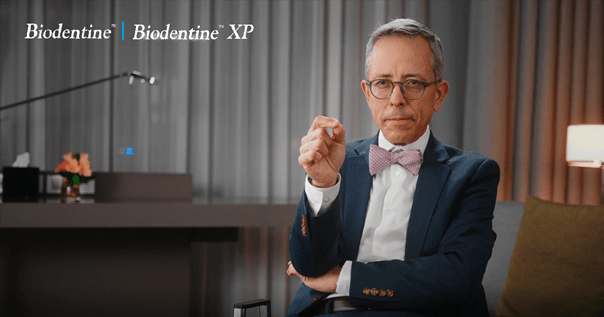
In this article, Dr. Juan Yepes (USA) reveals why Biodentine® has become his top pick to perform indirect pulp capping his young patients—helping him confidently preserve pulp vitality and achieve durable restorations using the Bio‑Bulk Fill technique.
Discover his practical insights and clinical tips—read the article now!
Maximizing Success in Indirect Pulp Capping with Biodentine® and the Bio-Bulk Fill Technique*
With Dr Juan Yepes, Professor of Pediatric Dentistry and Associate Dean for Graduate Education, Indiana University School of Dentistry and Riley Children’s Hospital
In teeth affected by deep caries, vital pulp has a natural capacity for healing if the bacterial challenge is removed and the tooth is suitably restored. Preserving the pulp has therefore become a high priority in contemporary endodontics, with more aggressive treatments being replaced by conservative, minimally invasive, and biologically based therapies like indirect pulp capping. Clinical data support the high success of this approach with Biodentine®, with reported success rates up to 99.24% in primary teeth after 3-12 months1 and 95.83% in young permanent molars after six months of follow-up². Here, Dr Juan Yepes explains what makes Biodentine® and indirect pulp capping a reliable combination for maintaining pulp vitality and long-term outcomes.
A brief history of indirect pulp capping
Now a commonly performed conservative procedure,3 indirect pulp capping is described by the European Society of Endodontology (ESE) as “the application of a biomaterial onto a thin dentine barrier in a one-stage selective caries removal technique.”4 It is recommended by the ESE for deep caries reaching the inner quarter of the dentine, where a layer of hard or firm dentine remains over asymptomatic or reversibly inflamed pulp.
Selective caries removal, as recommended by the ESE, is the excavation of soft (caries-infected) and firm (caries-affected) dentine from the peripheral aspect of the cavity until hard (sound) dentine is reached. A layer of firm dentine is left over the pulp to protect against irritation and accidental exposure. In contrast, non-selective caries removal, as recommended by the American Association of Endodontists (AAE), is the excavation of all firm and soft dentine from the entire cavity, leaving only hard dentine.5 In either case, a biomaterial like Biodentine® is then used to bulk-fill the cavity (Bio-Bulk Fill procedure), before topping with a final enamel restoration.
Biodentine®: The ideal material for indirect pulp capping
The success of indirect pulp capping is strongly influenced by the choice of restorative material. Given the close proximity to the pulp and the difficulty in accurately assessing dentine thickness over the pulp, the ESE recommends a biologically based material.4 Ideally, this material should:
Be biocompatible and well-tolerated by the tissues.
Promote (or at least not inhibit) dentine remineralization.
Create an inhospitable environment for residual bacteria.
Form a tight, long-lasting seal to keep new bacteria out.
Withstand normal occlusal forces over the long term.
When Dr Yepes graduated from dental school more than thirty years ago, this ideal material didn’t exist.
When I entered clinical practice in the 90s, indirect pulp capping was not an option. We simply didn’t have a material with the properties we needed to do indirect pulp caps successfully. I’ve witnessed a great evolution in materials since then, and Biodentine is the one I consistently recommend. It’s an excellent material that gives me all the properties I need for success in a deep cavity. ”
Therapeutic properties
Biodentine® is both a restorative material and a pulp therapeutic in one. Made from ultra-pure tricalcium silicate using patented Advanced Biosilicate (ABS) Technology™, Biodentine® is free from the heavy metals and other impurities found in calcium silicate cements like MTA.6,7,8 Moreover, Biodentine® has no mutagenic, sensitizing, irritant, or inflammatory effects on the pulp, even when the dentine barrier is thin, and has been shown in preclinical studies to be biocompatible.9,10,11 To the contrary, it actively works with the natural healing capabilities of the pulp, stimulating angiogenesis and growth factor release to enhance biologic healing.10,11
Dentine remineralization
As a bioactive material, Biodentine® promotes dentine remineralization through the formation of reactionary dentine and dentinal bridges.9,10,11,12,13 The high alkalinity degrades collagen at the dentine interface, creating a very porous surface and a distinct “mineral infiltration zone.”12,14 This allows for deeper diffusion of calcium, hydroxyl, and carbonate ions into the dentine tubules, increasing mineral deposition and remineralisation. 6,10,13,14,15,16,17
When compared to GIC, Biodentine® creates a more favorable environment for remineralisation.6,13 An in vitro study notably concluded that if both Biodentine® and GIC induce dentine remineralization, the dentine lesion remineralization capability of Biodentine® is higher than that of GIC.8
High alkaline pH
Selective caries removal inevitably leaves behind a certain amount of viable bacteria, so the material placed over the pulp should ideally provide a favorable environment to limit bacterial persistence. Thanks to its very high alkaline pH, Biodentine® creates an inhospitable environment for residual bacteria once placed.12,18,19 When compared to MTA and GIC in in vitro studies, Biodentine® demonstrates a higher potential to limit bacteria proliferation thanks to its alkaline pH.12
Tight seal
A successful indirect pulp cap requires a strong, durable seal. Biodentine® bonds tightly to the dentine wall via micro-mechanical anchorage, depositing mineral tags into the dentinal tubules.12,14 Further, in vitro studies have shown that Biodentine® is highly resistant to microleakage, creating a strong interface with fewer internal gaps and a tighter marginal seal when compared to GIC and MTA.12,20,21
Exceptional strength
When used as an indirect pulp capping material under a final composite restoration, Biodentine® closely mimics the properties of natural dentine to restore the structure and function of the tooth. Moreover, Biodentine®’s compressive strength continues to improve after application and gradually reaches the strength of natural dentine within 28 days13.
“The perfect dentine substitute” for Dr Yepes
In Dr Yepes’ opinion, these qualities make Biodentine® “the perfect dentine substitute” in successful deep caries treatment. He says:
“30 years ago, even those words – dentine substitute – would have been unbelievable. A material that provides all of the chemical and mechanical properties of natural dentine? Nobody would have imagined!”
Now, Biodentine® is a routine part of his daily practice. He typically uses it for indirect pulp capping with the Bio-Bulk Fill technique**, placing the material from the floor of the deep cavity all the way to the crown***. Unlike GIC, which generally must be built up layer by layer in thin increments in deep cavities, Biodentine® can be applied quickly and easily in a single bulk mass (Bio-Bulk Fill procedure). After a setting time of 12 minutes, the final enamel restoration can be placed over the Biodentine®, allowing Dr Yepes to complete the full indirect pulp cap in a single session.
This simplicity is especially valuable in Dr Yepes’ pediatric practice, where long procedures and repeat visits can be difficult for young patients. With Biodentine® and the Bio-Bulk Fill technique, he can provide reliable long-term results, even under less-than-ideal conditions, without compromising patient comfort or clinical outcomes.
Other long-term success factors in IPC
Beyond the choice of material, Dr Yepes highlights a number of other factors that dictate the long-term success of indirect pulp capping.
Diagnosis
“I’ve been doing this for a long time! And in my experience, the most critical success factor is a strong diagnosis with an appropriate indication for indirect pulp capping, which is reversible pulpitis. This is the foundation on which the success or failure of your treatment is built. If you miss the signs that the pulp is irreversibly inflamed, an indirect pulp cap is simply going to allow for continued bacterial assault, pulp necrosis, infection, and failure, not to mention pain and distress for the patient. This can be avoided from the start with a thorough clinical interview and oral examination.”
Depth of decay
If decay is too close to the pulp, there is a higher risk of complications like accidental pulp exposure and infection. The quality of the seal can also be compromised, increasing the risk of leakage and treatment failure. Radiographic images are valuable for assessing decay depth, but Dr Yepes warns that clinicians should err on the side of caution when interpreting these images:
“Remember that radiographs underestimate how deep decay is. So if you take a radiograph and see that decay is at the pulp, that very likely means it’s in the pulp. This tooth is not a good candidate for indirect pulp capping, and long-term success is unlikely.”
Patient capacity
Even when indirect pulp capping is clinically indicated, the patient’s age, cognitive ability, or behavior may be a barrier to success. This begins at diagnosis:
“I need to be able to understand the patient’s pain to make a sound clinical judgement. And if I have a three-year-old or a patient with a learning disability, they may not be able to explain their symptoms in enough detail for me to decide whether indirect pulp capping is appropriate.”
Of the procedure itself, he says:
“With younger patients, sometimes we want to do an indirect pulp cap, but their behavior can be challenging. Children are going to be children, of course, but I do need to ensure that we have some cooperation in order to be successful.” Although Dr Yepes prefers to place the final restoration in the same session, he notes that Biodentine® can be used in both one- and two-stage procedures. It can be left in place as a temporary enamel substitute for up to six months if necessary, giving him the flexibility to adapt to the patient’s needs on the day.
One area in which Dr Yepes is not flexible is the setting time. He recognizes that 12 minutes can feel like a long time for his young patients, but cautions strongly against cutting corners. First, he makes the patient feel like part of the team:
“I tell the child I’m going to use a special material, and it’s very important to keep it dry. I explain that if the material gets wet, we need to start again, so I need their help.”
Next, he distracts the patient with a story about encountering a talking deer in the park. By the time he reaches the end of his tale, the material is set, and the restoration can be placed.
Why patients love Biodentine® too
When it comes to patient satisfaction, the benefits of Biodentine® and Bio-Bulk Fill are obvious: less invasive treatments, reduced pain, enhanced healing, shorter procedures, and fewer visits. But as Dr Yepes points out, satisfaction in pediatric dentistry is not just about the patient.
“I don’t work with patients, I work with patients and parents. I cannot separate the two. Usually, the patient – a five-year-old, a seven-year-old – only cares about the shot or the waiting time. But the parents care about the benefits, and it’s a big deal to them. It makes me so proud to be able to tell them that I’m using the best material dentistry has to offer for their child. I get to tell them, you’re not going to find a better material than the one I’m using.
Later on, when the child comes back, we take a radiograph, and we see that the decay hasn’t progressed. The patient is asymptomatic. We’ve saved that tooth and changed the path of the child’s dental health. I love that, and I love that Biodentine® makes it possible. And I feel proud because I know that the parent will tell other parents, we take our children to Dr Yepes because he only uses state-of-the-art materials.”
With Biodentine®, you can rely on a clinically proven material for indirect pulp capping, supported by extensive scientific and clinical evidence.
Author Biography:
Dr. Juan Yepes DDS, MD, MPH, MS, DrPH, FDS RCS(Ed)
Juan F. Yepes is a full Professor in the Department of Pediatric Dentistry and the Associate Dean for Graduate Education at Indiana University School of Dentistry and an attending at Riley Children’s Hospital in Indianapolis, Indiana, USA.
Juan F. is board-certified by the American Boards of Pediatric Dentistry, Oral Medicine, and Dental Public Health. He is an active member of the American Academy of Pediatric Dentistry, American Academy of Oral Medicine, American Academy of Oral and Maxillofacial Radiology, Indiana Dental Association, and American Dental Association.
Juan F. is a fellow in dental surgery from the Royal College of Surgeons at Edinburgh. He is a member of the editorial board of Oral Surgery, Oral Medicine, Oral Pathology, and Oral Radiology. Finally, Juan F is the associate editor of the Journal of the American Dental Association (JADA).
Memberships:
American Academy of Pediatric Dentistry
International Association of Pediatric Dentistry
Royal College of Surgeons at Edinburgh
American Dental Association
American Academy of Oral Medicine
American Academy of Oral and Maxillofacial Radiology
The author reports no financial or professional relationships with Septodont related to this article. This content has an educational purpose and reflects the interpretation of the cited scientific literature. The statements appearing in quotation marks reflect Dr. Yepes’s own views and clinical experience. It does not replace the Instructions for Use.
This product is a Medical Device regulated with applicable requirements in the United States (FDA), European Union (MDR 2017/745), or other international markets.
Please read the instructions for use carefully before use, especially paying close attention to warnings, precautions, and contraindications. This medical device is a regulated health product. Communication to healthcare professionals only Date of document creation: [February, 2026].
* Disclaimer: This content has an educational purpose and reflects the interpretation of the cited scientific literature. The statements appearing in quotation marks reflect Dr. Yepes’s own views and clinical experience. It does not replace the Instructions for Use. ** Bio-Bulk Fill technique: use of Biodentine as a dentine substitute to fill the cavity from the pulpal area up to the dentine surface. *** Septodont internal document (Biodentine Expert Board – September 11, 2023).
References
Bastos, M.C., Araujo Albuquerque, F. G., Cetira Felho, E. L. et al. (2024) ‘Clinical and radiographic success of pulpotomy and pulpectomy in primary and permanent teeth: a systematic review and meta-analysis’, Journal of Clinical and Experimental Dentistry, 16(9), pp. 1120-1128. Available at: https://pmc.ncbi.nlm.nih.gov/articles/PMC11470449/
Kaul, S., Kumar, A., Jasrotia, A. et al. (2021) ‘Comparative Analysis of Biodentine®, Calcium Hydroxide, and 2% Chlorhexidine with Resin-modified Glass Ionomer Cement as Indirect Pulp Capping Materials in Young Permanent Molars’, Journal of Contemporary Dental Practice, 22(5), pp. 511–516. Available at: https://pubmed.ncbi.nlm.nih.gov/34318769/
Internal market research data.
Duncan HF, Galler KM, Tomson PL, et al. European Society of Endodontology position statement: Management of deep caries and the exposed pulp. Int Endod J. 2019;52(7):923–934.. Available at: https://onlinelibrary.wiley.com/doi/epdf/10.1111/iej.13080
Watson, T.F., Atmeh, A.R., Sajini, S. et al. (2014) ‘Present and future of glass-ionomers and calcium-silicate cements as bioactive materials in dentistry: biophotonics-based interfacial analyses in health and disease’, Dental Materials, 30(1), pp. 50–61. Available at: https://pmc.ncbi.nlm.nih.gov/articles/PMC3885799/
Hashem, D., Mannocci, F., Patel, S. et al. (2015) ‘Clinical and radiographic assessment of the efficacy of calcium silicate indirect pulp capping: a randomized controlled clinical trial’, Journal of Dental Research, 94(4), pp 562-568. Available at: https://pmc.ncbi.nlm.nih.gov/articles/PMC4485218/
Nowicka, A., Lipski, M., Parafiniuk, M. et al. (2013) ‘Response of human dental pulp capped with Biodentine and mineral trioxide aggregate’, Journal of Endodontics, 39(6), pp. 743–747. Available at: https://www.jendodon.com/article/S0099-2399(13)00133-7/abstract
Kaur, M., Singh, H., Dhillon, J.S. et al. (2017) ‘MTA versus Biodentine®: Review of literature with a comparative analysis’, Journal of Clinical and Diagnostic Research, 11(8), pp. ZG01–ZG05. Available at: https://pmc.ncbi.nlm.nih.gov/articles/PMC5620936/
Sajini, S., Atmeh, A., Banerjee, A. et al. (2022) ‘Glass-ionomer and calcium silicate-based cements interactions with human dentine in health and disease: Two-photon fluorescence microscopy and Raman spectroscopy analysis’, Dental Materials, 38(11), pp. 1710–1720. Available at: https://www.sciencedirect.com/science/article/abs/pii/S0109564122002536?via%3Dihub
Atmeh, A.R., Chong, E.Z., Richard, G. et al. (2012) ‘Dentin-cement interfacial interaction: calcium silicates and polyalkenoates’, Journal of Dentistry, 91(5), pp. 454–459. Available at: https://pmc.ncbi.nlm.nih.gov/articles/PMC4077527/
Elbanna, A., Atta, D., Sherief, D.I. (2022) ‘In vitro bioactivity of newly introduced dual-cured resin-modified calcium silicate cement’, Dental Research Journal (Isfahan), 28(19), p. 1. Available at: https://pubmed.ncbi.nlm.nih.gov/35308449/
Nowicka, A., Wilk, G., Lipski, M. et al. (2015) ‘Tomographic evaluation of reparative dentin bridge formation after direct pulp capping with calcium hydroxide, MTA, Biodentine, and dentin bonding system in human teeth’, Journal of Endodontics, 41(8), pp. 1234–1240. Available at: https://pubmed.ncbi.nlm.nih.gov/26031301/
Gong, V., Franca, R. (2017) ‘Nanoscale chemical surface characterization of four different types of pulp-capping materials’, Journal of Dentistry, 58, pp. 11-18. Available at: https://pubmed.ncbi.nlm.nih.gov/28043847/
Lundy, F.T., Giraud, T., El-Karim, I.A. et al. (2022) ‘Biodentine® in inflammation and pain control’, in About, I. (ed.) Biodentine: Properties and Clinical Applications. Switzerland: Springer, pp. 51–66. URL: https://link.springer.com/book/10.1007/978-3-030-80932-4
Niranjan, B., Shashikiran, N.D., Singla, S. et al. (2016) ‘A comparative microleakage evaluation of three different base materials in Class I cavity in deciduous molars in sandwich technique using dye penetration and dentin surface interface by scanning electron microscope’, Journal of Indian Society of Pedodontics and Preventive Dentistry, 34(4), pp. 324–330. Available at: https://pubmed.ncbi.nlm.nih.gov/27681395/
Abdelmegid, F. Y., Salama, F. S., Al-Mutairi, W. M., et al. (2017) ‘Effect of different intermediary bases on microleakage of a nanocomposite interface in Class II box cavities in primary teeth: An in vitro study’, International Journal of Artificial Organs, 40(2), pp. 82-87. Available at: https://pubmed.ncbi.nlm.nih.gov/28222209/
Live webinars and webinar replays to learn from the best speakers in dentistry.
Educational content in a variety of formats (articles, podcasts, clinical cases, videos, and more) to enhance your skills and achieve business success.
Our Voice of Customer program to contribute in creating innovative products that address your needs.




 Free access